Chashma Right Bank Canal
“For centuries we have learned to live with this land, in hardships, but with a knowledge that allowed us to build our community, a relationship to a land and its waters that defines our very being. The languages of the land have taught us to how to cherish and harness the hill torrents brought by the rains to provide us sustenance. And in doing so we became the knowledge that allows this land to live and us to live as it.”
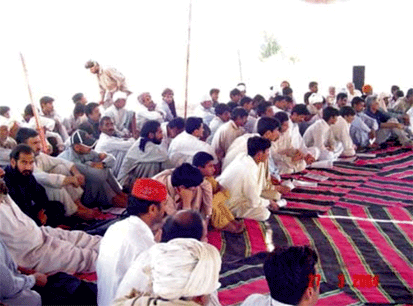
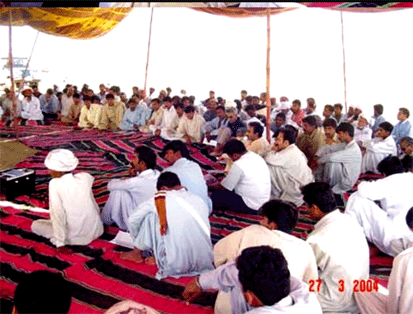
The Chashma Right Bank Canal (CRBC) created a world juxtaposed against many worlds in Daman. Daman was defined by people’s unique ways of being in and knowing those worlds, and by their capacity to sustain themselves through the strenuity of life that shaped Daman’s social and ecological fabric.
The CRBC flattened those worlds, thrusting people into a new market and causing radical departure from old ways of being in Daman. For instance, before CRBC, people grew crops oriented toward use-value and self sustenance. With the canal, however, they were forced to shift to cash crops, commodying their relationship with the land which ultimately created new dependencies that were entirely structured around the market. The people of Daman were sold a dream that the project would bring prosperity. Instead, through flooding and displacement, the canal was a constantly evolving nightmare.
-
The Asian Development Bank(ADB) funded Chashma Right Bank Irrigation project is a large-scale irrigation project that constructed a 274 kilometer long canal along the River Indus, 72 distribution canals, 68 cross drainage structures, and 91 bridges. The remaining funding of the project was provided by the German KfW Bank and the Government of Pakistan. The Water and Power Development Authority (WAPDA) was responsible for implementing the project.
-
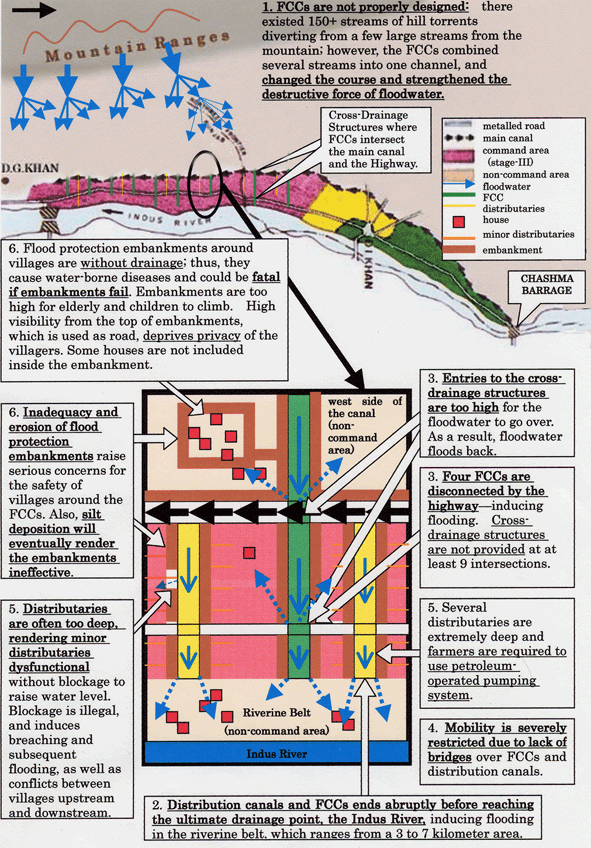
The key design flaw in the project relates to the flows of the rowd-kohee (hill torrents), which have never flowed in a consistent pattern. Indigenous farmers, utilising the knowledge that has been passed down across generations, were able to ascertain the direction of this flow and use it to grow food crops, enough to provide sustenance for the local communities.
The ADB and WAPDA claimed - against the warnings of the locals - that they would use their complex methodologies and ‘technical expertise’ to determine the directionality of these flows and that no villages would be flooded in the process. The canal aimed to turn the area from a barani or rain-fed region into a perennially irrigated system that could be used to achieve a growth in agricultural output and increase the efficiency of water distribution. They set out to achieve the impossible - to harness nature and force it to follow their ways.
Their hubris, however, was quick to catch up to them. The supposedly superior methodologies utilised to determine the direction of the rowd kohee amounted to a paltry guess upon which the entire project was built. Both the ADB and WAPDA continually exposed themselves by constantly changing their statements with regards to the project. At first, they claimed that no village would be flooded. Over time, the statement was altered to reflect what was actually happening, forcing them to acknowledge the reality that several villages would have to be flooded and displaced. In the end, twenty-two villages to the left of the main canal and more than fifty villages in the Indus riverine belt were displaced due to blockage of floodwater caused by the canal.
-
The land acquisition process for the project was based on the 1894, colonial era Land Acquisition Act that allowed the authorities to usurp the land from the locals without informed consent or proper compensation at market rate. While the ADB itself was appalled by the delays in the compensation process, it refused to compensate or quantify the loss of community and way of life that the locals had grown up with. Neither did it fully acknowledge the extent to which it was responsible for the problem.
Furthermore, the land acquisition process was conducted under opaque methods and without the consultation of the community, paying them amounts that were much lower than the actual value of the land.
-
After decades of making the locals dependent on this new irrigation system, the 2022 floods brought in a new devastation for the communities. The intensity of the floods had washed away $500 million worth of crops and rendered the canal useless, leaving the locals with nothing. The ADB was silent on the matter as too much time had passed since the completion of the project for them to engage their accountability mechanism. This raises the question of how ill-equipped these accountability mechanisms are to deal with projects that have consequences well beyond their loan maturity dates. Inevitably, the real losses are never faced by those who are responsible as they are able to create arbitrary mechanisms that shield themselves from such consequences in the future.
The Chashma Lok Sath represented a rejection of the terms being imposed on the local community. Instead of seeking justice in a language that they did not speak, the Lok Sath demanded that the planners enter unfamiliar territory and engage with the locals directly, without the protections afforded to them by their own systems. Representatives from the ADB and WAPDA attended the meetings to listen to the pleas of the locals and made vague promises to make a difference. Through their fight, the Lok Sath were able to gain significant ground, including an exemption from a water tax and compensation for some of the land losses caused by the project. Most importantly, the fight reinvigorated the self-confidence of the community according to Fazal Rab. They refused to be beholden to the status of losers of development and instead fought to preserve their dignity.
The Alternative Law Collective has been involved heavily in championing the voices of the Chashma Lok Sath and assisted them in engaging with WAPDA and the ADB. A documentary and a website were created to highlight the struggles created by the Chashma canal to highlight the issues faced by the local community. Since the 2022 floods, it has attempted to communicate with the ADB consistently to bring attention to the losses faced by the locals due to the canal’s poor planning.